Site items in: Asia

IEA Completes Two Power-to-Ammonia Reports
Article

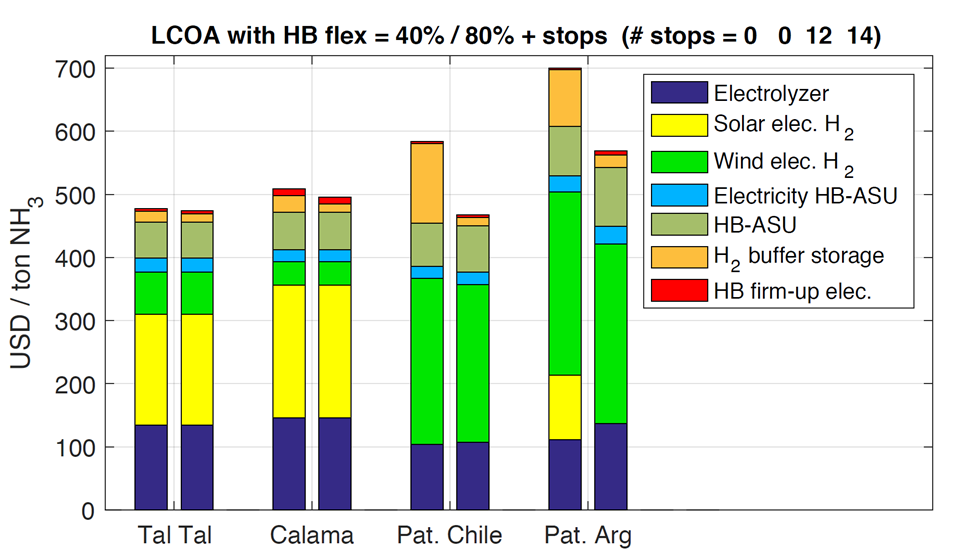
The International Energy Agency has completed two reports that examine the economics of hydrogen and ammonia production based on wind and solar electricity generation.  Both reports were written by IEA Consultant Julien Armijo under the supervision of IEA Senior Analyst Cédric Philibert.  One focuses on China and formalizes the findings and conclusions that were the subject of a February 2019 Ammonia Energy post.  The other focuses on Chile and Argentina.  Both reports cast an encouraging light on the near-term cost-competitiveness of green ammonia vs. conventionally produced brown ammonia in specific national markets.
New Video Summarizes SIP Energy Carriers Accomplishments
Article

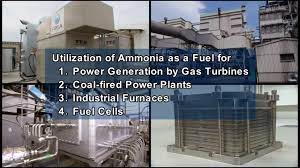
ANNOUNCEMENT: The Japanese Government’s Cabinet Office and the Japan Science and Technology Agency have released an English-language video that summarizes the accomplishments of the Cross-Ministerial Strategic Innovation Promotion Program’s Energy Carriers initiative.  The release coincides with the end-of-March conclusion of Energy Carriers’ work, and anticipates this month’s formal activation of the Green Ammonia Consortium.

METI Releases Major Revision to Hydrogen Roadmap
Article

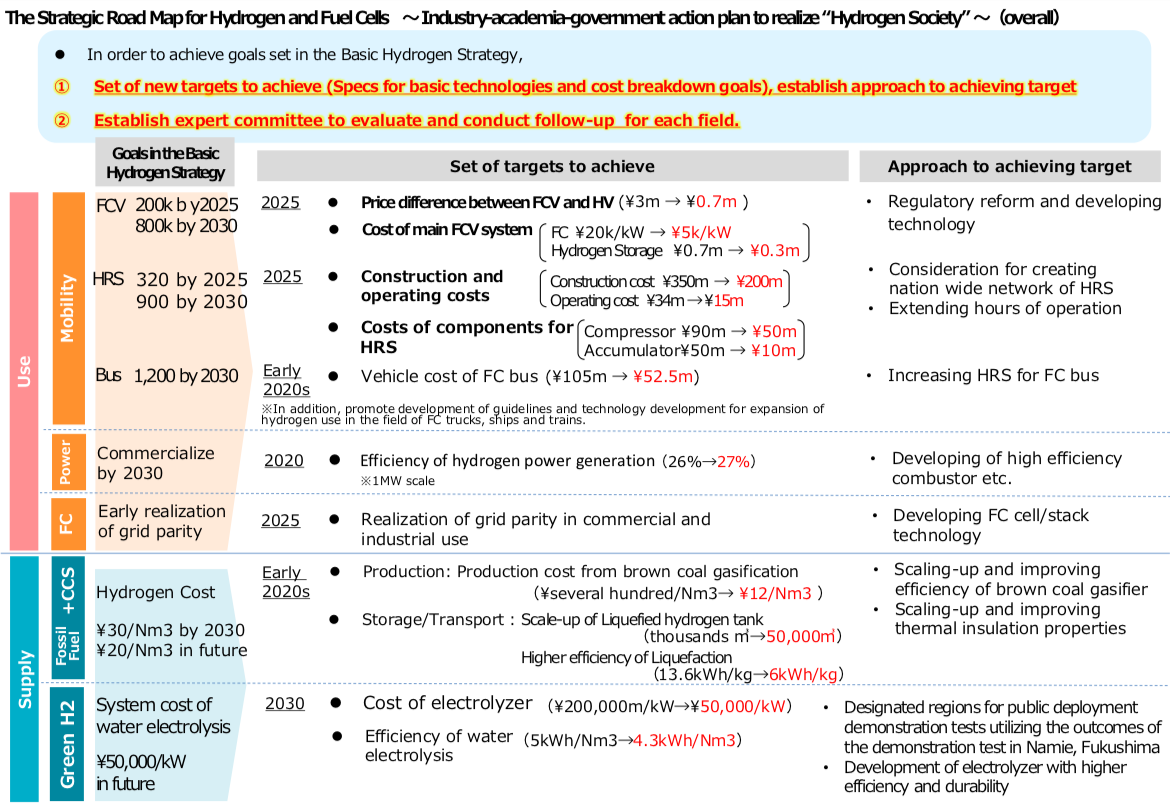
Japan’s Ministry of Economy, Trade and Industry (METI) announced on March 12 that it had released a “major revision” to the country’s Hydrogen and Fuel Cell Strategy Roadmap.  The Roadmap was first formulated in 2014 to “secure the goals set forth in the Basic Hydrogen Strategy and the 5th Basic Energy Plan for the realization of a hydrogen society.”  The Roadmap’s last revision in 2016 predates new editions of the foundation documents that were released in December 2017 and July 2018, respectively.

IEA Analysis: Green Chinese P2A Could Compete with Brown NH3
Article

The IEA has developed a rigorous economic model to examine the proposition that resource intermittency can be managed by siting hydrogen facilities where variable renewable energy (VRE) resources have complementary daily and seasonal production profiles. Last month, IEA Senior Analyst Cédric Philibert shared modeling results from selected sites in China with an audience at the Energy Research Institute in Beijing.  The exercise offers a first quantitative look at two important questions.  First, what is the economic impact of "VRE stacking"?  And second, what is the relative cost position of ammonia produced via a stacking approach? 

Rapid Long-Term Growth Projected for Fuel Cells
Article

Last month the Fuji-Keizai Group released its latest biennial review of the global market for fuel cells, “Future Outlook for Fuel Cell-Related Technology and Market in 2018.”  This is at least the third iteration of the report, and comparison across the different editions shows how expectations have evolved.  The report features both polymer electrolyte and solid oxide fuel cells.  Although not mentioned in the report, a number of groups are working on direct ammonia versions of both technologies.

Ammonia's Role in the Hydrogen Society
Article

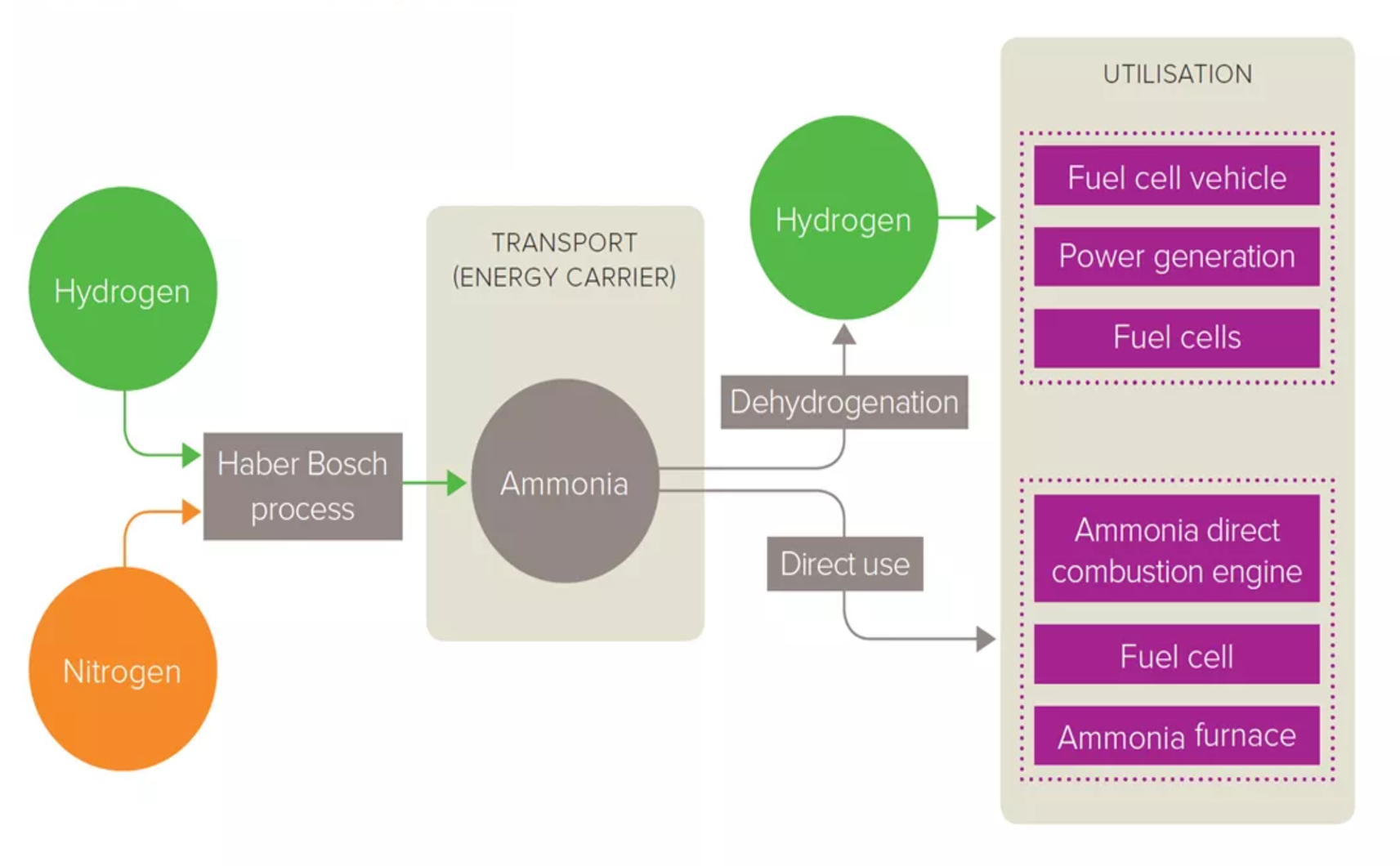
Last month I had the opportunity to reflect on “Ammonia’s Role in the Hydrogen Society.”  This was the title of a speech I gave at the Ammonia Energy International Workshop in Tokyo.  The Workshop was held on January 25 by the Energy Carriers initiative of the Japanese Government’s Strategic Innovation Promotion Program (SIP) as it moves toward its terminal date of March 31, and as the Green Ammonia Consortium, which grew out of the Energy Carriers program, prepares for its official launch in the same time frame.  The key takeaways from my speech are that ammonia is widely seen as a contributor to the viability of hydrogen energy, but the extent of its potential role is not appreciated.

JGC Corporation demonstrates
Article

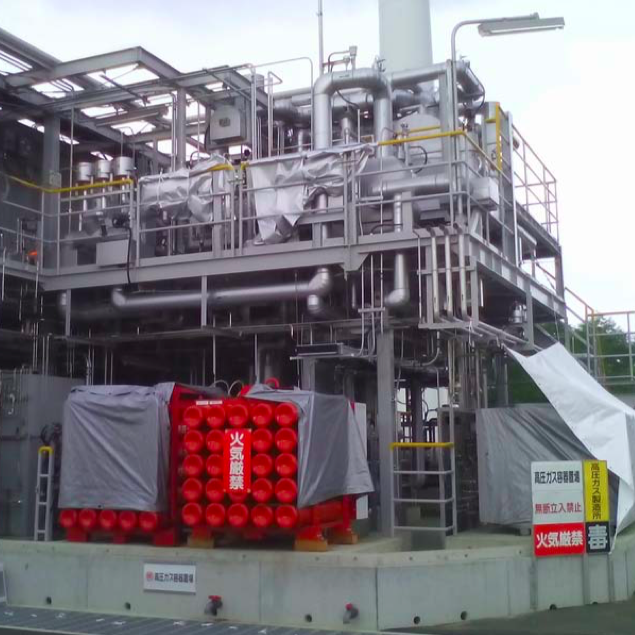
In late 2018, JGC Corporation issued a press release to celebrate a "world's first" in ammonia energy, demonstrating at its pilot plant in Koriyama both "synthesis of ammonia with hydrogen produced through the electrolysis of water by renewable energy, and generation of electricity through gas turbines fueled by synthesized ammonia." By demonstrating the feasibility of using ammonia on both sides of the renewable energy equation -- first, producing green ammonia from intermittent renewable electricity and, second, combusting this carbon-free fuel for power generation -- the project demonstrates the role of ammonia in the "establishment of an energy chain ... that does not emit CO2 (CO2-free) from production to power generation."

Development of Technologies to Utilize Green Ammonia in the Energy Market - Update on Japan's SIP Energy Carriers
Article

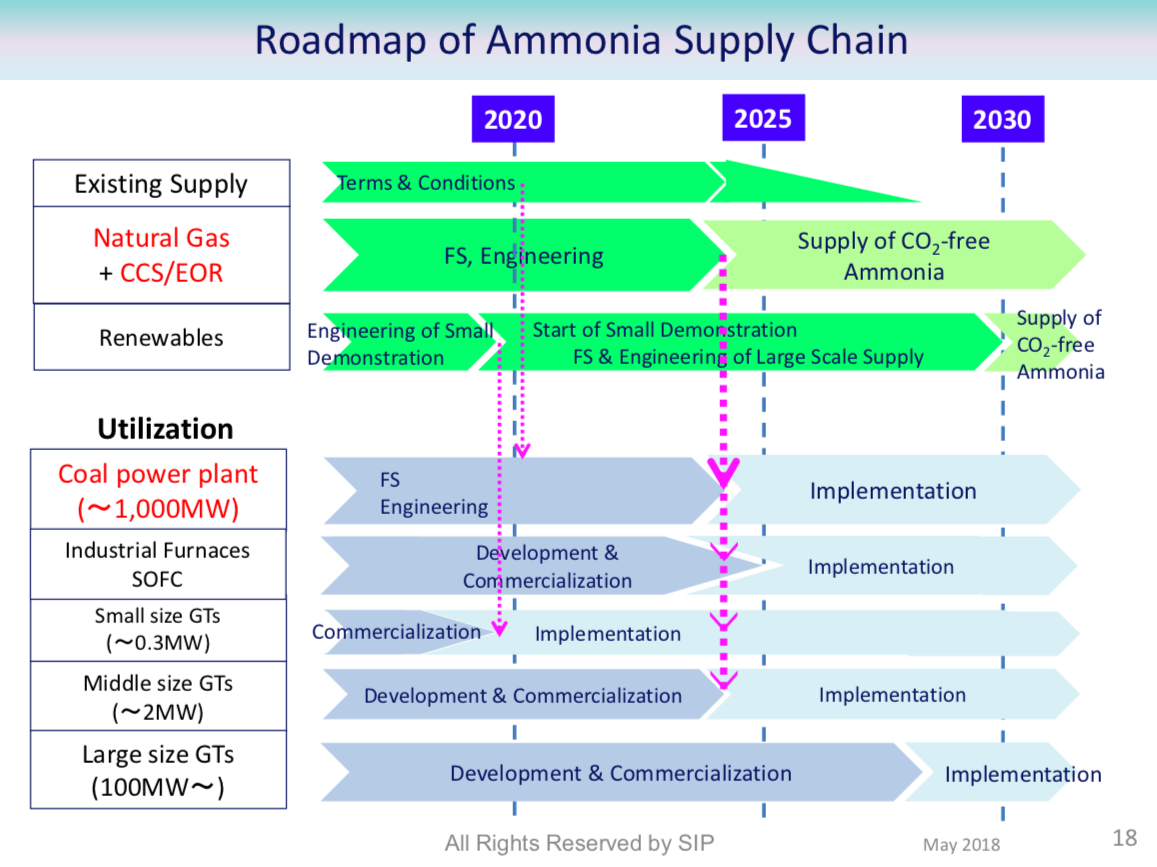
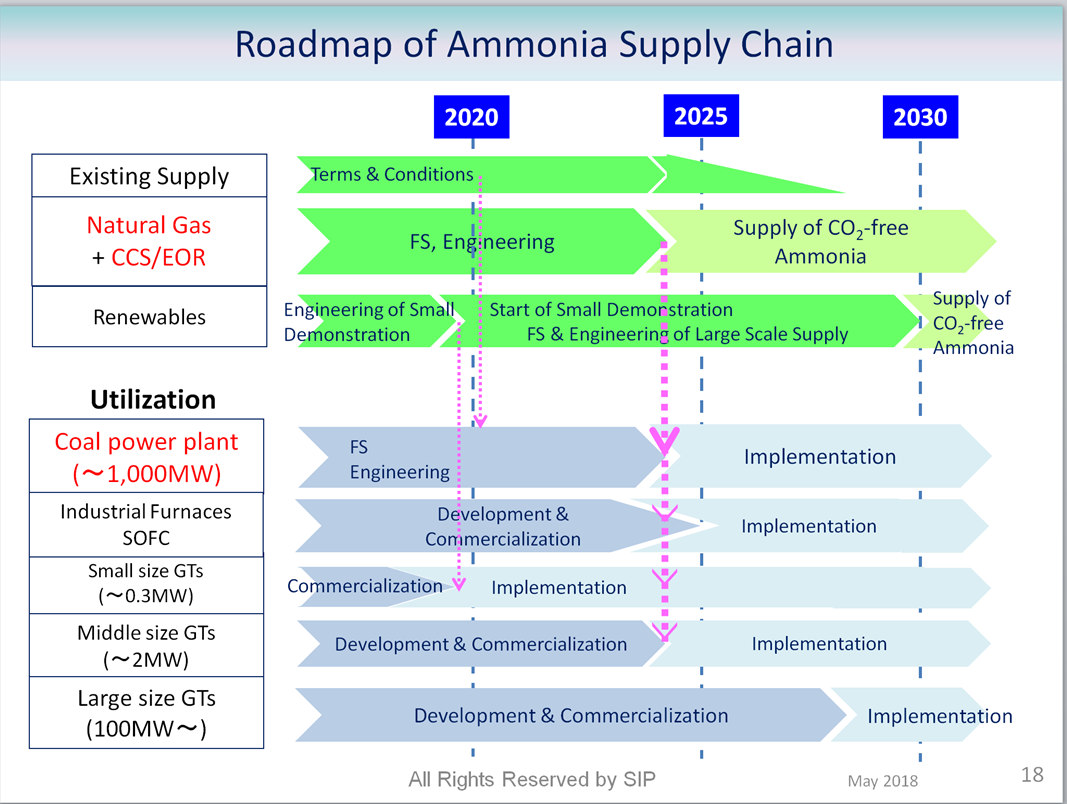
At the recent NH3 Energy Implementation Conference in Pittsburgh, USA, the keynote speech was given by Shigeru Muraki, Program Director of Japanese government's SIP Energy Carriers project. Muraki is also Chairman of the Green Ammonia Consortium, which will assume responsibility for coordinating the development and deployment of ammonia energy technologies in Japan when the SIP concludes in April 2019. Given both these roles, Muraki was well placed to address not only the recent years of intense research and development in Japan, but also the near-term roadmap for commercial deployment of ammonia energy technologies.

NH3 Energy Implementation Conference: A Brief Report
Article

The 2018 NH3 Energy Implementation Conference, the first of its kind, took place on November 1 in Pittsburgh, Pennsylvania in the U.S. The focus of the Conference was on steps – current and future – that will lead to implementation of ammonia energy in the global economy.  At the highest level, the Conference results validated the relevance and timeliness of the theme.  In the words of closing speaker Grigorii Soloveichik, Director of the U.S. Department of Energy’s ARPA-E REFUEL Program, the Conference strengthened his confidence that “ammonia is a great energy carrier ... with billions of dollars of potential in prospective markets.”