Site items in: Europe

Ammonia-to-Hydrogen Seen for Electricity Generation
Article

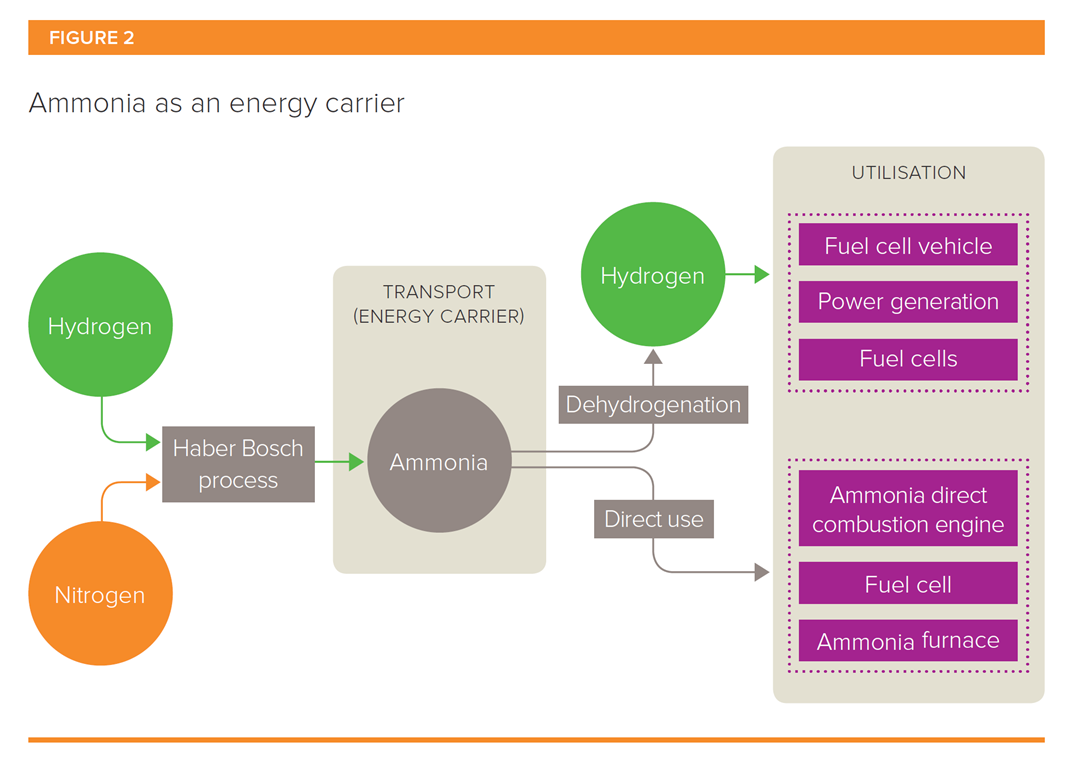
Approximately 40% of the world’s energy budget is consumed in the generation of electricity.  This is by far the largest use of primary energy across major energy-consuming sectors (transportation, industry, etc.).  What role ammonia will play in the electricity sector is therefore a question of considerable importance for the sustainable energy system of the future.  One concept currently on the table is power-to-ammonia as a means of electricity storage, whereby electricity is used to produce hydrogen and the hydrogen is reacted with nitrogen to produce ammonia.  The other, mirror-image, concept is to use ammonia, or hydrogen derived from ammonia, as a fuel that can be turned into electricity. This “back-end” use case is the focus of recent announcements from Mitsubishi Hitachi Power Systems (MHPS).  According to an April 5 story in the Nikkei Sangyo, MHPS plans to put a “hydrogen-dedicated gas turbine . . . into practical use by 2030.”  The company also stated that it has “started developing technology to extract hydrogen from ammonia,” citing ammonia’s ease “to store and transport.”
Joyn Bio: microbial engineering for sustainable nitrogen
Article

Six months ago, in September 2017, I reported a $100 million joint venture announcement between Bayer and Ginkgo Bioworks that aimed to engineer nitrogen-fixing microbes, which could be put into seed coatings and provide nutrients to non-legume crops. Now, the joint venture has been named, and Joyn Bio is staffing up. For the ammonia industry, this represents potential demand destruction at a significant scale in the coming decades.

Yara's N-Tech Platform: Making Strides with Green Ammonia
Article

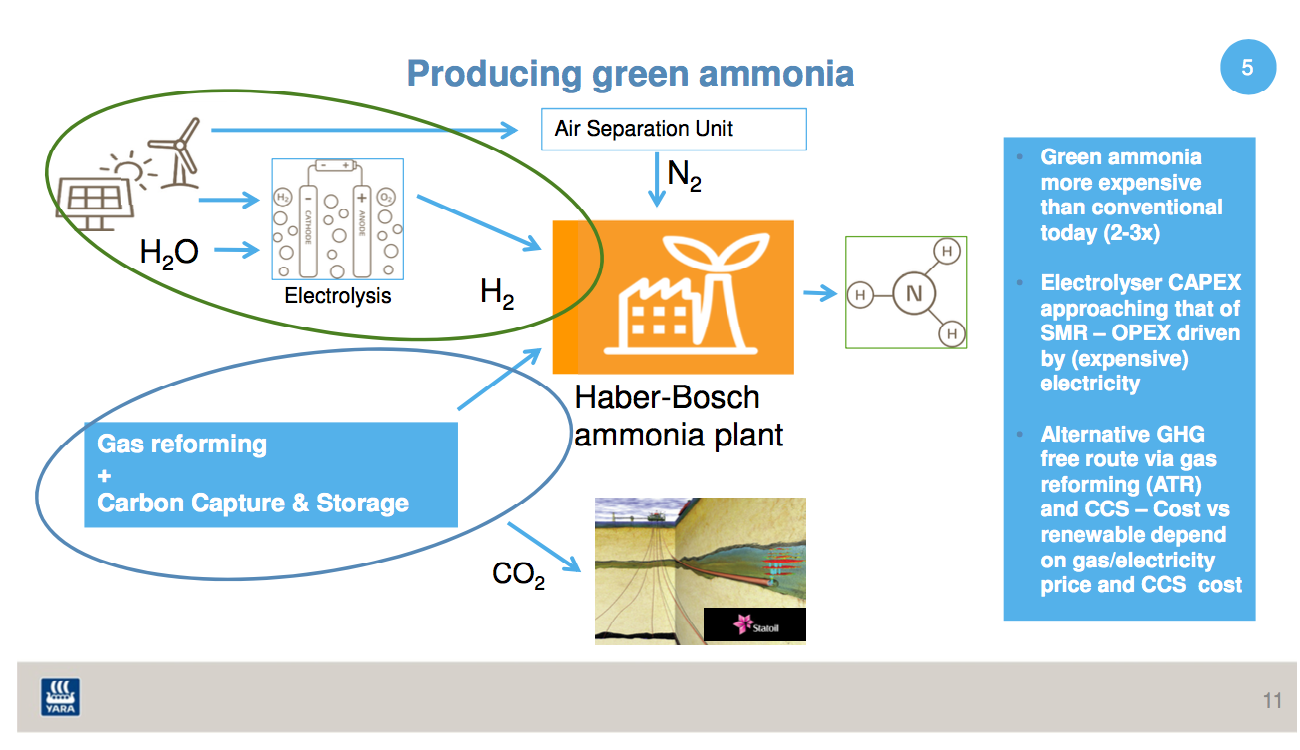
Yara International, one of the world’s largest ammonia producers, is making strides in its development of green ammonia as a fertilizer, chemical intermediate, and energy carrier.  The progress is documented in the company’s 2017 annual report, released last week, and in more detail in a presentation delivered in late February at the 2018 Nitrogen + Syngas Conference in Gothenburg, Sweden.

Ammonia technology portfolio: optimize for energy efficiency and carbon efficiency
Article

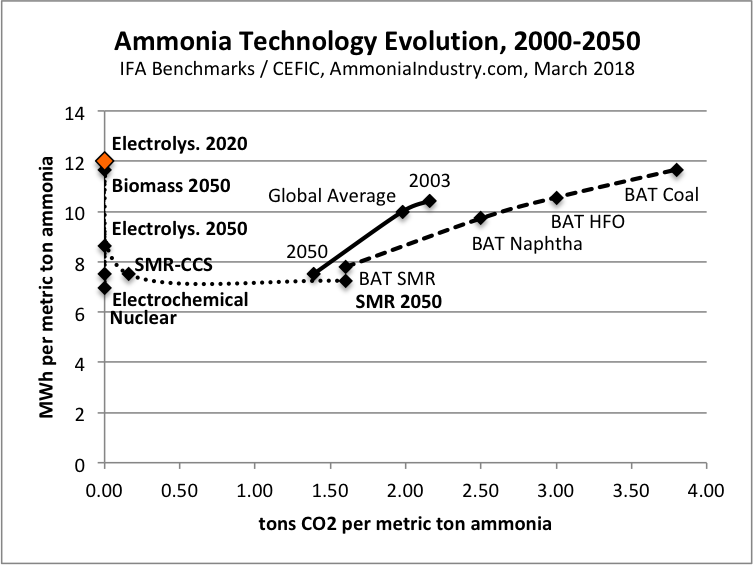
Earlier this month, I had the pleasure of speaking at the International Fertilizer Association's (IFA) conference on the subject of Innovations in Ammonia. A key point was the benefit of technology diversification: as with any portfolio, whether an investment account or a global industry's range of available technologies, concentration in any area represents risk, and diversification represents resiliency. Unfortunately, the ammonia industry has grown highly concentrated, and its dependency upon one technology and one feedstock represents significant risk in tomorrow's markets. This article features five charts that aim to demonstrate why energy efficiency is insufficient as the only measure of technology improvement, why it is better to optimize instead of maximize, and why market evolution is necessary to support investment decisions in sustainable ammonia synthesis technologies.

Renewable ammonia energy, harvesting large-scale wind
Article

A chemicals technology firm in Belgium recently launched its vision for using green ammonia for "energy harvesting." The Dualtower is a new kind of wind turbine, under development by Arranged BVBA, that will use wind power to produce and also store hydrogen and nitrogen. These gases are "harvested" as ammonia, which becomes the energy carrier that allows large-scale renewable energy to be transported economically from remote locations with excellent renewable resources to centers of power consumption. Arranged's Dualtower is ambitious and, perhaps, futuristic but it illustrates three powerful concepts. First, the vast untapped scalability of renewable power. Second, the benefits of using ammonia as an energy carrier, to improve the economics of large-scale, long-distance energy transportation relative to every other low-carbon technology. The third concept is simply that every idea has its time, and now may be the time for ammonia energy. What was once futuristic, now just makes sense.

Battolyser B.V. Formed in the Netherlands
Article

Proton Ventures and Delft University of Technology (TU Delft), both of the Netherlands, announced in early February the formation of a new company, Battolyser B.V.  The company’s initial goal is to build and demonstrate a pilot version of the eponymous technology that stores electricity and produces hydrogen.  Hans Vrijenhoef, who will direct the new company, indicated that a fully realized system would include an ammonia production train so that the hydrogen could be stored and transported at low cost.  Vrijenhoef is already the Director of Proton Ventures B.V., a member of the NH3 Fuel Association’s Global Federation Advisory Board, and the originator of the NH3 Event power-to-ammonia conference.

Importance of Public Perception towards an Ammonia Economy
Article

During development of the technical aspects of any energy project, a social perspective needs to be considered. Public opinion is going to be a fundamental parameter to determine the role of renewables in the future, with decarbonisation meaning innovation towards a comprehensive plan that involves not only technology but also psychology and how these two can benefit from each other. Due to the importance of understanding public perception of ammonia, Cardiff University conducted a study focused on the Yucatan Peninsula, Mexico, which currently presents high revenues in agriculture and depends on ammonia as a fertiliser. An analysis of stakeholder’s perception of ammonia was carried out to understand the different barriers and drivers of each established group.

Royal Society Releases Low-Carbon Hydrogen Briefing
Article

On February 8, the Royal Society released a policy briefing entitled “Options for producing low-carbon hydrogen at scale.”  The briefing evaluates the technical and economic aspects of hydrogen production methods and concludes that it is indeed feasible to produce low-carbon hydrogen at scale.  Part of that feasibility, the briefing says, could be based on the use of ammonia as an expedient for hydrogen transport and storage.