Site items in: Asia

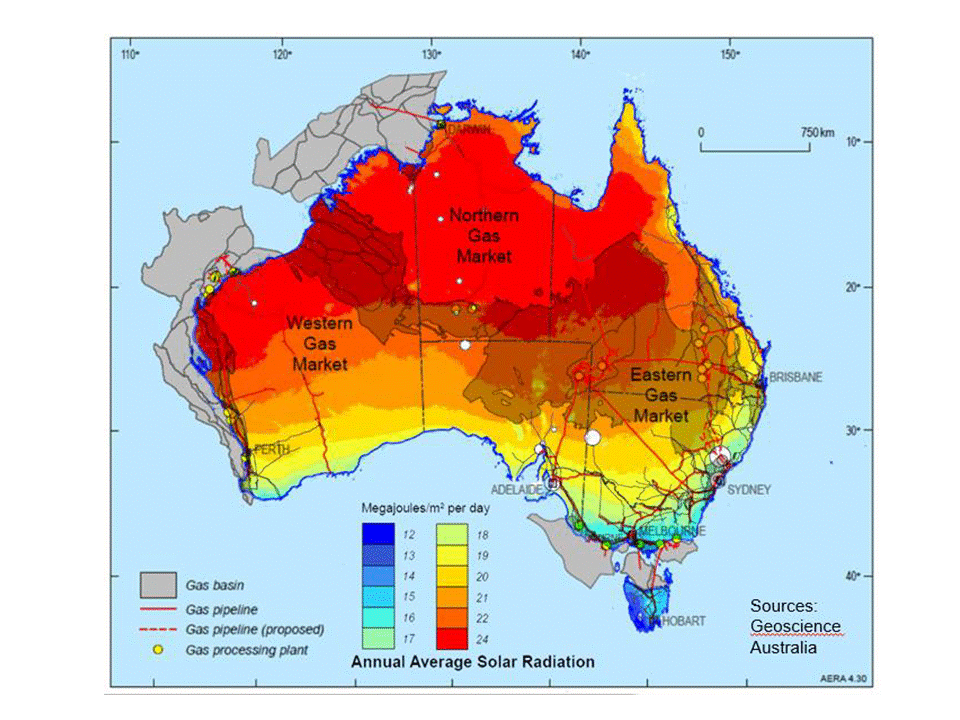
Australia's Concentrated Solar Fuels Program
Article

Solar ammonia' could be the key to the sustainable energy economies of two nations. During his talk at the 2016 NH3 Fuel Conference, Keith Lovegrove, Head of Solar Thermal at IT Power Group in Australia, said that Japan and Australia have the opportunity to move their trade in energy onto a climate-friendly foundation. This would involve development of Australia's solar resources in a way that helps Japan ramp up its Strategy for Hydrogen & Fuel Cells in the coming decades.
A Roadmap for Ammonia Fuel in Fujian Province
Article

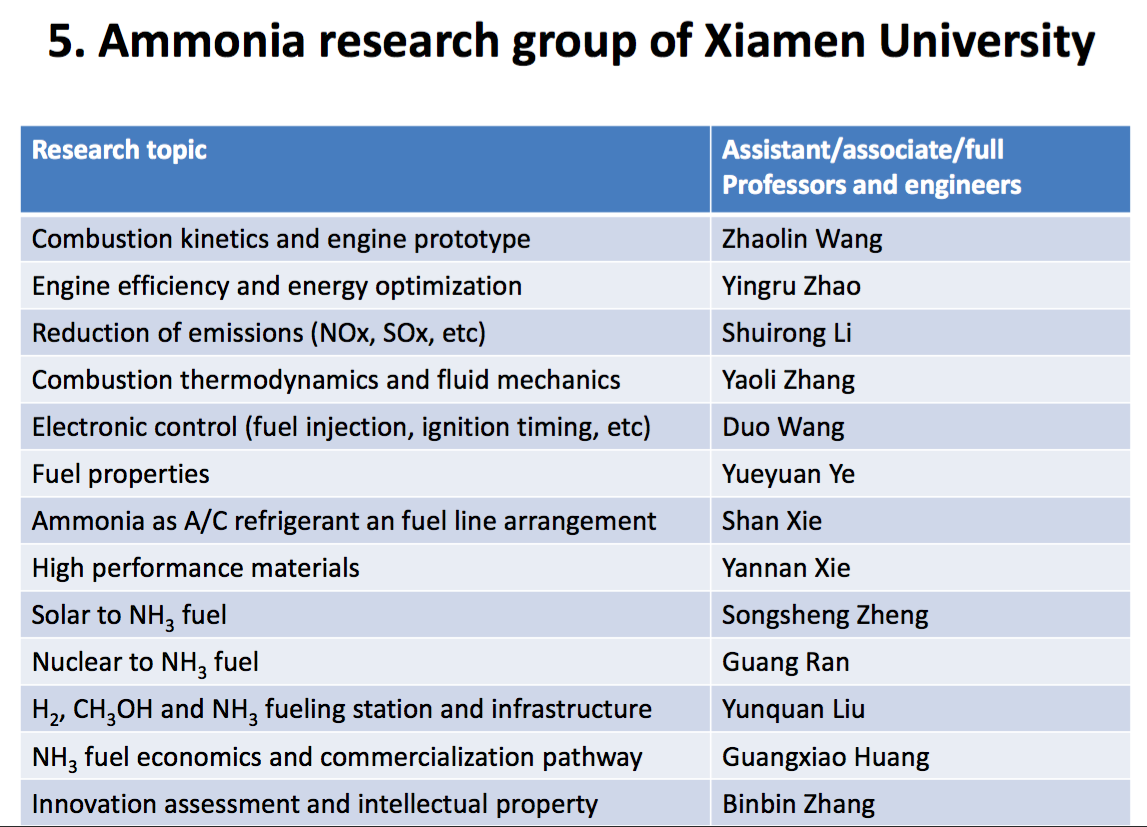
Researchers from Fujian Province presented their work at the 2016 NH3 Fuel Conference, and introduced the far-reaching plans of the Ammonia Fuel Synergy group at the College of Energy, Xiamen University, in China. Forest (Zhaolin) Wang's presentation, Ammonia as a Key to Meeting the Fuel Demand of China, contained valuable insight into the potential of ammonia fuel in China, and outlined the group's roadmaps for developing an ammonia-natural gas dual fueled car by 2018, and an ammonia-methanol dual fuel car by 2020.

Ammonia Turbine Power Generation with Reduced NOx
Article

A common concern with ammonia fuel is that NOx emissions will be too high to control. However, in new research from Turkey, USA, and Japan, presented at this year's NH3 Fuel Conference in September 2016, two things became clear. First, NOx emissions can be reduced to less than 10ppm by employing good engineering design and exploiting the chemical properties of ammonia, which plays a dual role as both the fuel and the emissions-cleanup agent. Second, the deployment of ammonia-fueled turbines for power generation is not only feasible, but actively being developed, with demonstration units running today and improved demonstration projects currently in development.

Japan's Fourth Strategic Energy Plan
Article

The Cabinet of the Government of Japan adopted the country’s Fourth Strategic Energy Plan in April 2014. The Plan includes a Strategy for Hydrogen & Fuel Cells which is being executed by the Ministry of Economy, Trade and Industry (METI). The accompanying H2/FC Road Map includes an investigation of three materials that can carry the energy embodied in molecular hydrogen: liquid hydrogen, organic hydrides such as methylcyclohexane, and ammonia.

The AmVeh – an ammonia fueled car from South Korea
Article

South Korean researchers have successfully road-tested a dual fuel passenger car that runs on a mixture of ammonia and gasoline. It is called the AmVeh and was developed by members of the Ammonia Research Group at the Korean Institute for Energy Research. The prototype vehicle uses a fuel ratio of 70% ammonia to 30% gasoline to power a spark ignition engine. As ammonia contains no carbon, this fuel ratio results in a corresponding 70% reduction in carbon dioxide emissions, compared to pure gasoline. The AmVeh team is now focused on improving the fuel system and the exhaust after-treatment system. Once these are optimized, they aim to develop an engine system that runs on ammonia alone, without any support from gasoline.