Site items in: Content by Author Trevor Brown

Call for Abstracts: Ammonia Energy Conference 2019 submission deadline
Article

ANNOUNCEMENT: Call for Abstracts closes next week - Deadline April 12! Our 16th annual Ammonia Energy Conference is tentatively scheduled to take place on November 13-14, 2019, as part of the AIChE Annual Meeting in Orlando, Florida. If you wish to make a presentation, please submit your abstract via the AIChE website, making sure to select the Topical Conference: Ammonia Energy.

HIAlba-IDEA: think tank launches in Scotland to deploy CSIRO technology, become green energy exporter
Article

NEWS BRIEF: A new policy think tank was launched last month that will focus on "why and how Scotland could benefit from being an early adopter of renewable hydrogen." Its "core starting point" is CSIRO's hydrogen-purification membrane, which enables ammonia to be used and exported as an efficient hydrogen carrier; for this use, green ammonia would be produced from offshore wind. According to the founders, this could lead to "Scotland becoming one of the largest global energy exporters in the world ... it could be the country’s main source of energy and create a knowledge economy."

Green ammonia: Haldor Topsoe's solid oxide electrolyzer
Article

Haldor Topsoe has greatly improved the near-term prospects for green ammonia by announcing a demonstration of its next-generation ammonia synthesis plant. This new technology uses a solid oxide electrolysis cell to make synthesis gas (hydrogen and nitrogen), which feeds Haldor Topsoe's existing technology: the Haber-Bosch plant. The product is ammonia, made from air, water, and renewable electricity. The "SOC4NH3" project was recently awarded funds from the Danish Energy Agency, allowing Haldor Topsoe to demonstrate the system with its academic partners, and to deliver a feasibility study for a small industrial-scale green ammonia pilot plant, which it hopes to build by 2025. There are two dimensions to this technology that make it so important: its credibility and its efficiency.

Ammonia plant revamp to decarbonize: Yara Pilbara
Article

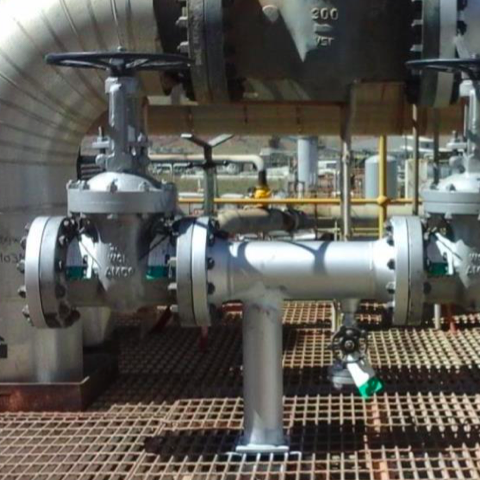
This week, Yara announced major progress toward producing "green ammonia" at its plant in Pilbara, Australia. Its new partner in this project is ENGIE, the global energy and services group, which last year made a major commitment to developing large-scale renewable hydrogen projects. I first reported Yara's plans for a solar ammonia demonstration at its Pilbara plant in September 2017. This week's announcement means that the Pilbara project has moved to the next feasibility phase. However, major elements of the project have already been designed and built: during last year's scheduled turnaround for plant maintenance, the hydrogen piping tie-in was completed - meaning that the Haber-Bosch unit is ready to receive hydrogen directly, as soon as an electrolyzer has been built to supply it with renewable feedstock.

UK Department of Transport recommends launch of ammonia / hydrogen powered vessels within 5-15 years
Article

In January 2019, the UK Department for Transport published a policy paper outlining its vision for the maritime sector over the coming decades. Among the many recommendations contained in Maritime 2050: navigating the future, is a medium-term objective to place "a group of hydrogen or ammonia powered domestic vessels in operation." The "strategic ambition" driving this recommendation is the expectation that "the UK will ... lead the way in taking action on clean maritime growth enjoying economic benefits from being an early adopter or fast mover." Moving forward, these recommendations will be developed into policy in the government's forthcoming Clean Maritime Plan, scheduled to be published in Spring 2019.

Ammonia plant revamp to decarbonize: Yara Sluiskil
Article

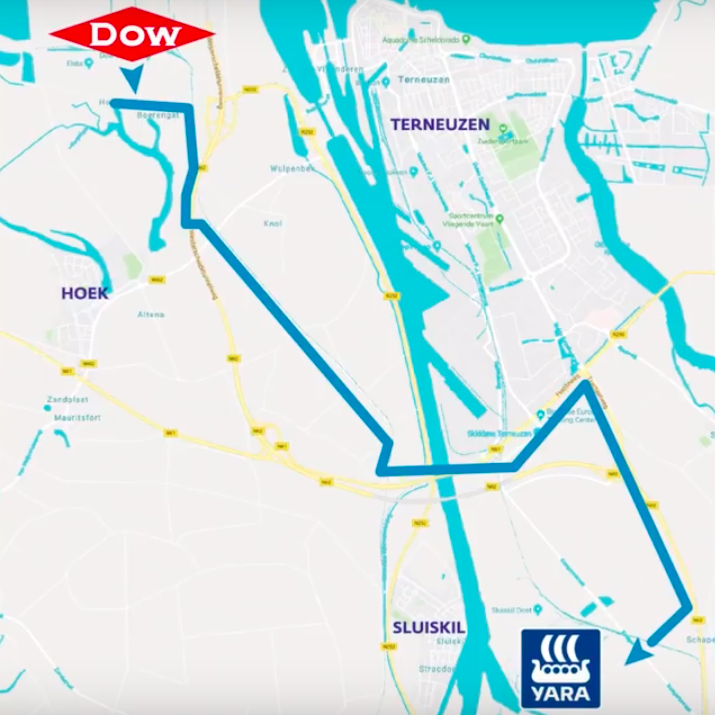
Last year, Yara Sluiskil, in the Netherlands, upgraded its existing ammonia plant by introducing a hydrogen pipeline connection, thereby reducing its reliance on fossil fuels. The pipeline was commissioned in October 2018 and now "ensures the efficient and safe transport of hydrogen," which was previously a waste-product at Dow's nearby ethylene cracker. Already, the project "delivers a CO2 saving of 10,000 tons" and a decrease in energy consumption of "0.15 petajoules (PJ) per year." This is, perhaps, the first ammonia plant decarbonization revamp, and it shows that it is both possible and affordable to reduce emissions from existing ammonia plants today.

MAN Energy Solutions: an ammonia engine for the maritime sector
Article

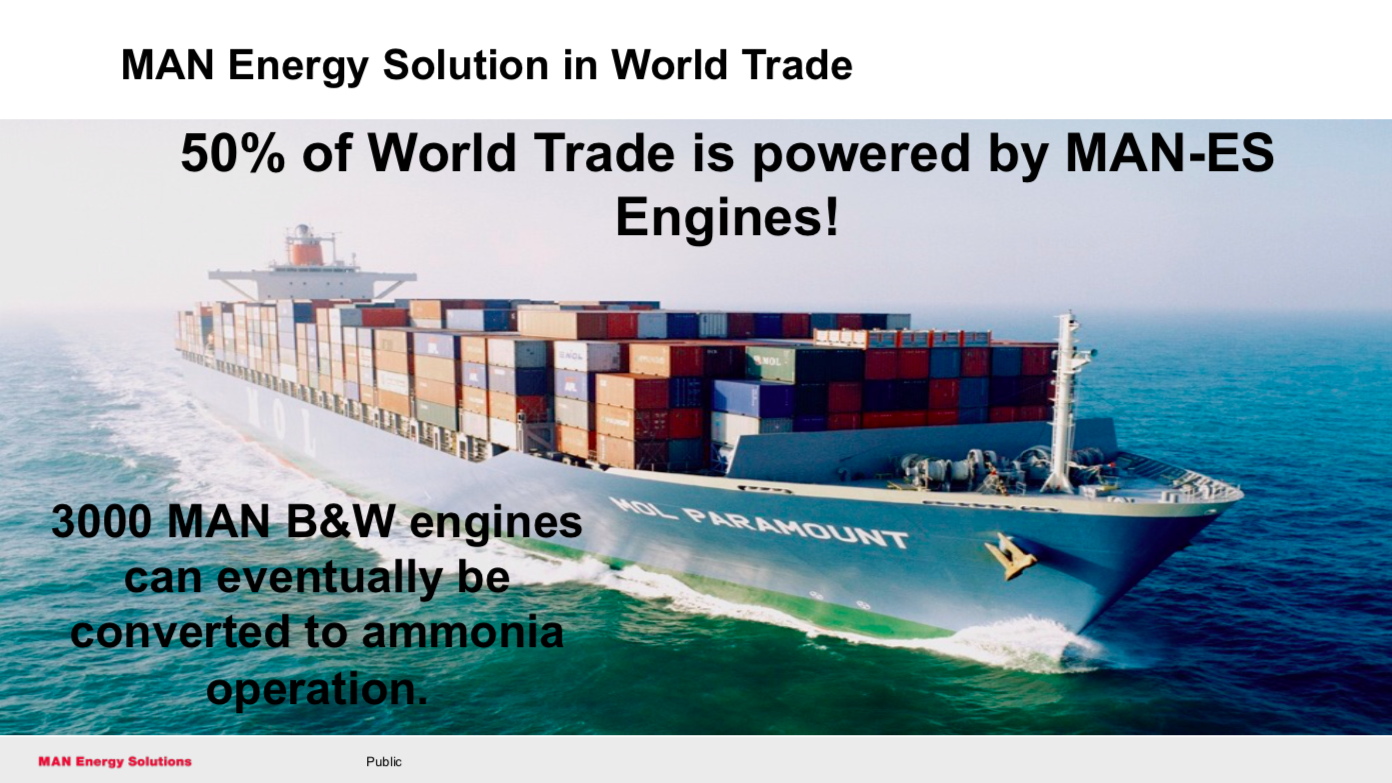
In June 2018, MAN Diesel & Turbo rebranded itself MAN Energy Solutions, reflecting the maritime engine market leader's "strategic and technological transformation" towards sustainability. The company was "taking a stand for the Paris Climate Agreement and the global pursuit of a carbon-neutral economy." According to Uwe Lauber, Chairman of the Board, "our activities have a significant impact on the global economy. In shipping, for example, we move more than half of the global stream of goods ... [and] the path to decarbonising the maritime economy starts with fuel decarbonisation, especially in container shipping." This week, the company took a significant step towards realizing its vision, disclosing that it is "pressing ahead with developing ... an ammonia-fuelled engine." This builds on the technology development pathway that MAN ES presented at the NH3 Energy+ Topical Conference at Pittsburgh in October 2018. The budget and timeline are set: the €5 million (USD$5.7 million) project will last two to three years and, if the shipowners decide to deploy the finished product, "the first ammonia engine could then be in operation by early 2022."

Mission Possible: decarbonizing ammonia
Article

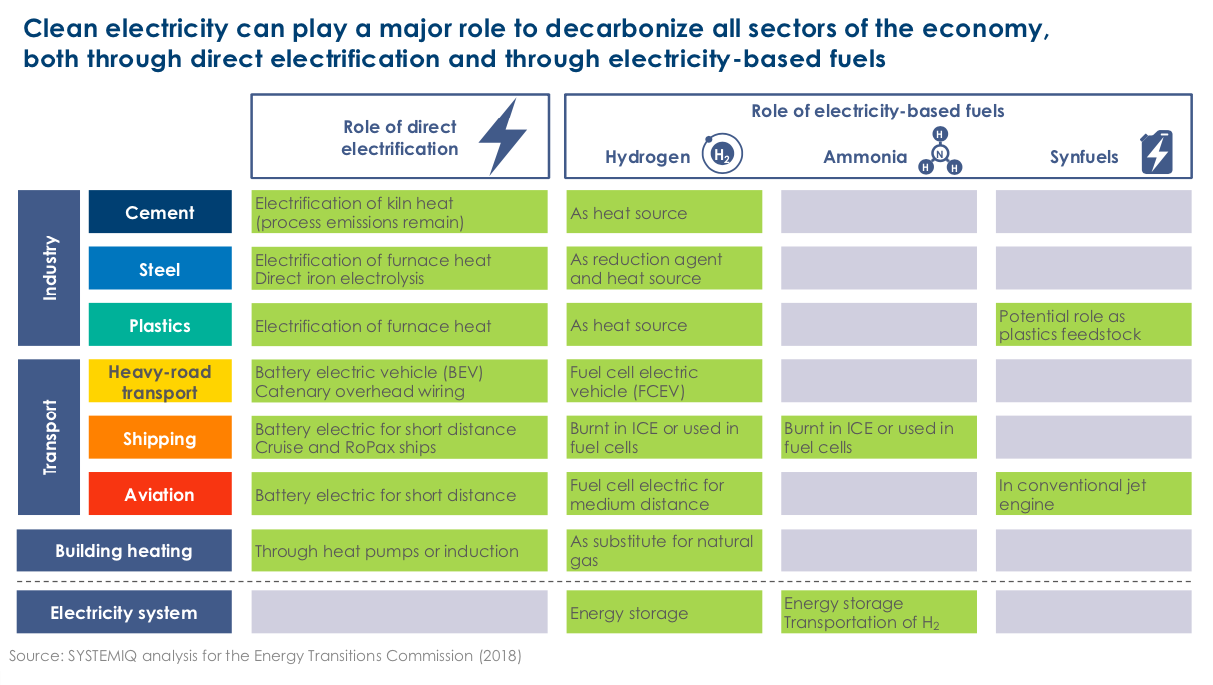
Mission Possible, a major report published at the end of 2018, concludes that decarbonizing ammonia production by 2050 is both technically and economically feasible. Among its 172 pages of assumptions, analysis, and explanation, Mission Possible examines production pathways and markets for green ammonia and its derivative green nitrogen fertilizers. It addresses the relatively straightforward issue of how to replace fossil feedstocks with renewable hydrogen for ammonia synthesis, as well as the more complex question of how to source or supplant the carbon dioxide molecules contained in urea, the most common nitrogen fertilizer. The report's economic conclusions will not surprise anyone involved in ammonia production or politics. Yes, green ammonia is currently more expensive than fossil ammonia, although it won't be for long. And no, "none of the increases in end-consumer prices are sufficiently large to be an argument against forceful policies to drive decarbonization."

Mission Possible: a roadmap for net-zero emissions in the heavy industry and heavy-duty transport sectors
Article

Mission Possible, a recent report published by the Energy Transitions Commission, presents an extremely detailed roadmap for "Reaching net-zero carbon emissions from harder-to-abate sectors by mid-century." The report is designed to support the targets of the Paris Agreement by sending "a clear signal to policymakers, investors and businesses: full decarbonization is possible, making ambitious climate objectives achievable." Ammonia is one of the crucial solutions that make Mission Possible possible. In its 172-pages, the report details the technologies and the economics behind decarbonizing ammonia, the "likely" adoption of ammonia as the carbon-free fuel of choice for long-distance shipping, and the "key role" ammonia will play in enabling international trade in renewable power.