Site items in: Content by Author Trevor Brown

A Roadmap for Ammonia Fuel in Fujian Province
Article

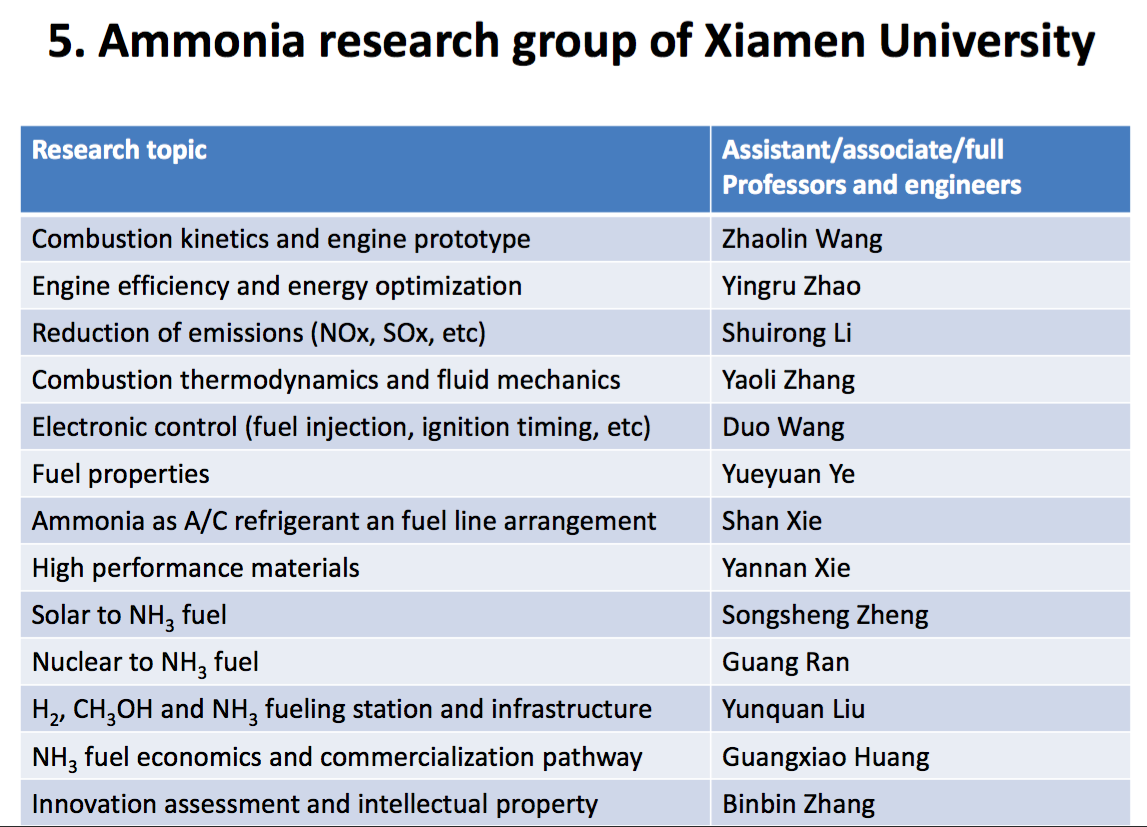
Researchers from Fujian Province presented their work at the 2016 NH3 Fuel Conference, and introduced the far-reaching plans of the Ammonia Fuel Synergy group at the College of Energy, Xiamen University, in China. Forest (Zhaolin) Wang's presentation, Ammonia as a Key to Meeting the Fuel Demand of China, contained valuable insight into the potential of ammonia fuel in China, and outlined the group's roadmaps for developing an ammonia-natural gas dual fueled car by 2018, and an ammonia-methanol dual fuel car by 2020.
Ammonia Fuel Cells: SOFC stack test and system analysis
Article

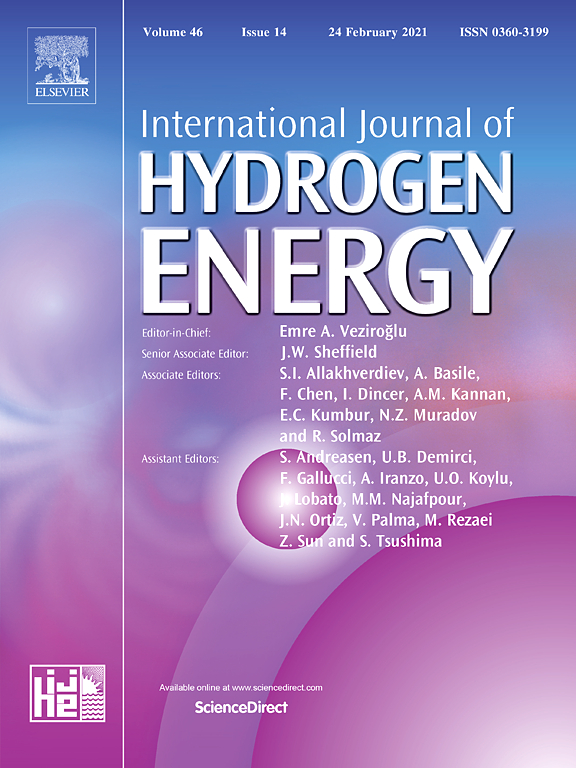
New research, recently published in the International Journal of Hydrogen Energy, demonstrates that solid oxide fuel cell (SOFC) systems fueled with ammonia could be "more efficient than equivalent hydrogen-based" systems. This new paper comes out of the Fuel Cell Lab at the University of Perugia, in Italy, and builds upon years of research coming out of that laboratory on the use of ammonia and urea in fuel cells.

Ammonia Turbine Power Generation with Reduced NOx
Article

A common concern with ammonia fuel is that NOx emissions will be too high to control. However, in new research from Turkey, USA, and Japan, presented at this year's NH3 Fuel Conference in September 2016, two things became clear. First, NOx emissions can be reduced to less than 10ppm by employing good engineering design and exploiting the chemical properties of ammonia, which plays a dual role as both the fuel and the emissions-cleanup agent. Second, the deployment of ammonia-fueled turbines for power generation is not only feasible, but actively being developed, with demonstration units running today and improved demonstration projects currently in development.

The Investment Case for Sustainable Ammonia Synthesis Technologies
Presentation

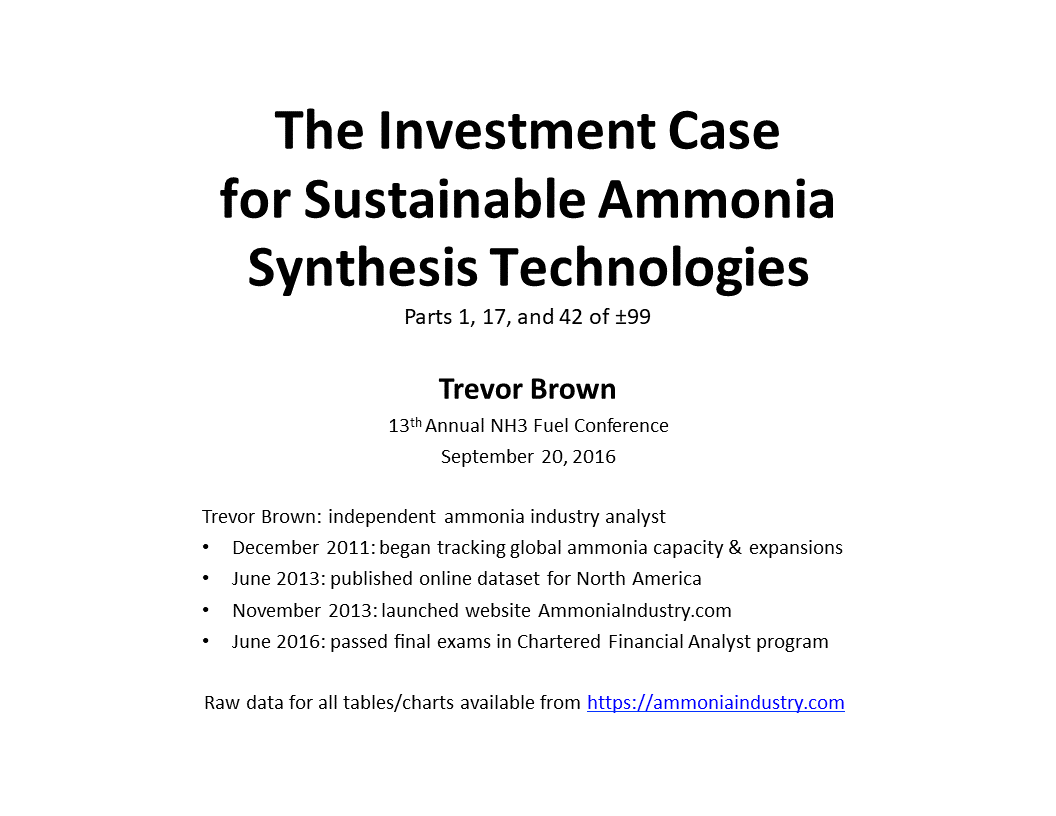
For 100 years, we have made ammonia with the Haber-Bosch process, almost always using a fossil fuel feedstock. Recently, though, government policy, academic innovation, commercial opportunity, and human morality have combined to spur the development of new, “green” ammonia manufacturing processes: sustainable, low-carbon technologies. These new synthesis methods augur a future in which, instead of the single, over-riding drive toward the economies of scale associated with Haber-Bosch, an array of different feedstocks, uses, and business models will support a multiplicity of competing technologies serving multiple markets. This presentation aims to introduce the factors affecting the appetite for commercialization and adoption…

Displacing Diesel Fuel with Carbon-Free Anhydrous Ammonia
Article

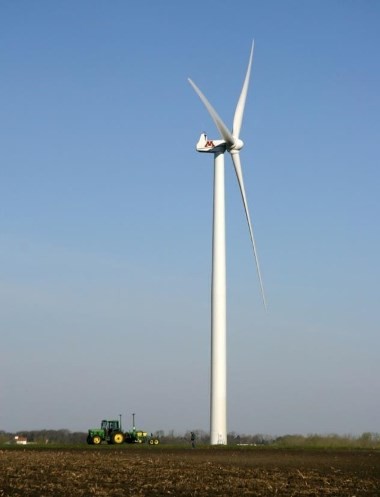
The team at the University of Minnesota announced last month the award of funding for a demonstration project entitled "Clean Vehicles Fueled by Hydrogen from Renewable Ammonia." This project builds on years of research and investment in renewable ammonia at University of Minnesota, most visibly the prototype wind-to-ammonia production plant operating since 2014 at West Central Research and Outreach Center. Their focus now, however, is shifting to the use of ammonia as a fuel. "The overall objective of the project is to displace up to 50% of the diesel fuel used in tractors with anhydrous ammonia produced from renewable resources."

Study on Reduced Chemical Mechanisms of Ammonia / Methane Combustion under Gas Turbine Conditions
Article

On September 1st, academic journal Energy & Fuels published a new paper that features research coming out of the UK's Cardiff University and Ireland's University of Limerick. This study demonstrates a "reduced mechanism" for simulating the "robust numerical analyses with detailed chemistry" necessary for the "industrial implementation" of ammonia in gas turbine combustion for "future power generation." Here's the abstract:

Project Alkammonia: Ammonia-fed Alkaline Fuel Cells
Article

Following last year’s field trials of Diverse Energy’s PowerCube technology in Africa (and AFC Energy’s subsequent acquisition of assets from Diverse), an EU-funded project to commercialize ammonia-fed fuel cells for stationary power generation continues to gather momentum under the title “Project Alkammonia".