Site items in: North America

The Future of Ammonia: Improvement of Haber-Bosch ... or Electrochemical Synthesis?
Article

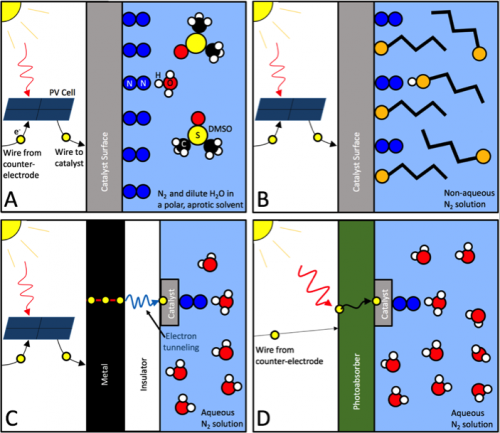
During our NH3 Energy+ Topical Conference, hosted within AIChE's Annual Meeting earlier this month, an entire day of presentations was devoted to new technologies to make industrial ammonia production more sustainable. One speaker perfectly articulated the broad investment drivers, technology trends, and recent R&D achievements in this area: the US Department of Energy's ARPA-E Program Director, Grigorii Soloveichik, who posed this question regarding the future of ammonia production: "Improvement of Haber-Bosch Process or Electrochemical Synthesis?"

Renewable Energy for Industry: IEA's vision for green ammonia as feedstock, fuel, and energy trade
Article

This morning in Beijing, China, the International Energy Agency (IEA) launched a major new report with a compelling vision for ammonia's role as a "hydrogen-rich chemical" in a low-carbon economy. Green ammonia would be used by industry "as feedstock, process agent, and fuel," and its production from electrolytic hydrogen would spur the commercial deployment of "several terawatts" of new renewable power. These terawatts would be for industrial markets, additional to all prior estimates of renewable deployment required to serve electricity markets. At this scale, renewable ammonia would, by merit of its ease of storage and transport, enable renewable energy trading across continents. The IEA's report, Renewable Energy for Industry, will be highlighted later this month at the COP23 in Bonn, Germany, and is available now from the IEA's website.

254th ACS Meeting, Energy and Fuels Symposium “The Ammonia Economy” — Oxidation, Catalytic Cracking & Storage
Article

In August of 2017 a symposium on the Ammonia Economy was held in Washington DC as part of the Energy and Fuels Division of the American Chemical Society (ACS) conference. The symposium was devised to explore the latest results from ammonia related research, including but not limited to; advances in the generation of ammonia, advances in the catalytic cracking of ammonia to nitrogen and hydrogen, ammonia storage and utilisation, detectors and sensors for ammonia, ammonia fuel cells and hydrogen from ammonia, ammonia combustion and ammonia safety.

254th ACS Meeting, Energy and Fuels Symposium “The Ammonia Economy” — Synthesis, Utilization & Nitrogen Reduction
Article

In late August, the day before the exciting solar eclipse, the Ammonia Economy symposium was held as part of the Energy and Fuels Division of the American Chemical Society (ACS) National Meeting in Washington DC. This marks the third gathering of Ammonia related research since 2015 at the national level ACS conference. This year, in addition to the important focus on chemistries for the utilization of ammonia, the rapidly developing field of homogeneous catalysts and biological processes for nitrogen fixation was included as a major theme.

ARPA-E talks advanced hybridization, carbon-neutral liquid fuels
Article

In the race to place the automotive sector on a sustainable footing, the field is dominated by just two horses: battery-electricity and hydrogen fuel cells.  The economic implementation of BEVs is already well underway, with motor companies on track in 2017 to sell more than a million vehicles globally for the first time.  The economic implementation of FCVs is also in progress, albeit at a much earlier stage, and has the backing of major motor companies and public-sector agencies.  Given the huge leads enjoyed by electricity and hydrogen, ammonia is scarcely seen as a contending fuel.  Earlier this month, though, the U.S. Department of Energy’s ARPA-E unit published an interview with two of its program managers that has an intriguing implication: the race is far from over and ammonia may yet break to the front of the pack.

The Dawn of Bio-Ammonia
Article

In the last 12 months ... Bio-engineering has set its sights on ammonia. If we could deliver ammonia-emitting microbes to the soil we might make ammonia fertilizer obsolete; on the other hand, if we could farm them, we might establish ammonia as a new, carbon-free algal biofuel.