Site items in: Presentations

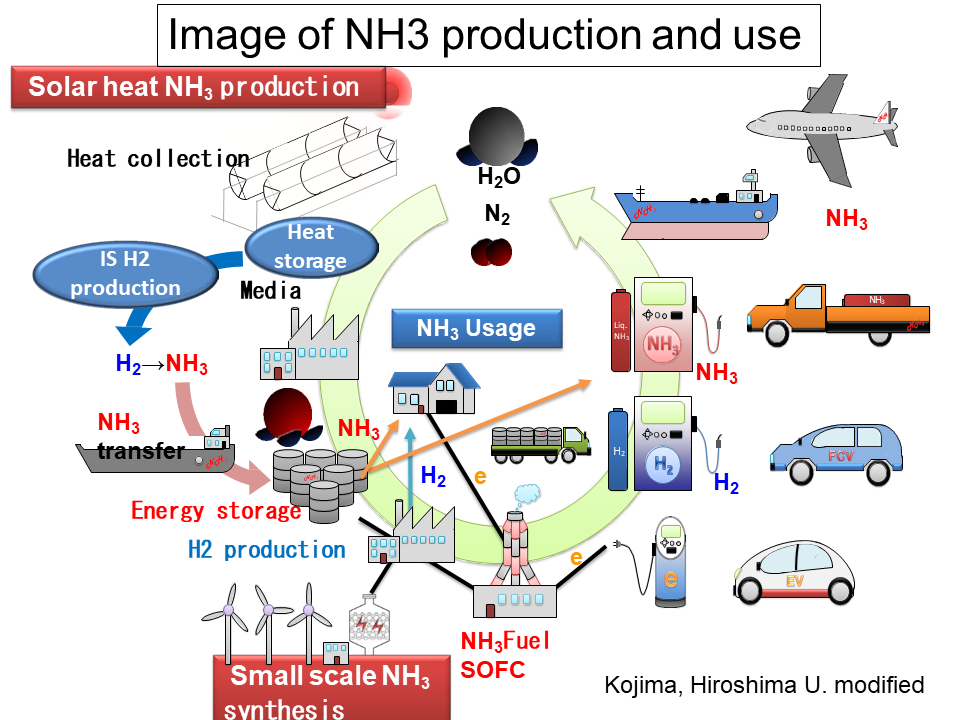
Ammonia as an Energy Carrier for Renewable Energy
Presentation

At present, ammonia is mostly formed through reforming of natural gas (CH4). A 1,000 ton per day plant is said to consume about 35 GJ of natural gas to produce 1 ton of ammonia (22.5 GJ of enthalpy). About 50% of extra energy is wasted. If 1 ton ammonia is produced through water electrolysis, 22.5 GJ of electricity is necessary theoretically. Here again, extra electric energy must be wasted. The author discusses roughly how the efficiency depends upon the process size and the renewable energy cost.
Ammonia as a Motor Vehicle Engine Fuel from a Weights and Measures Perspective
Presentation

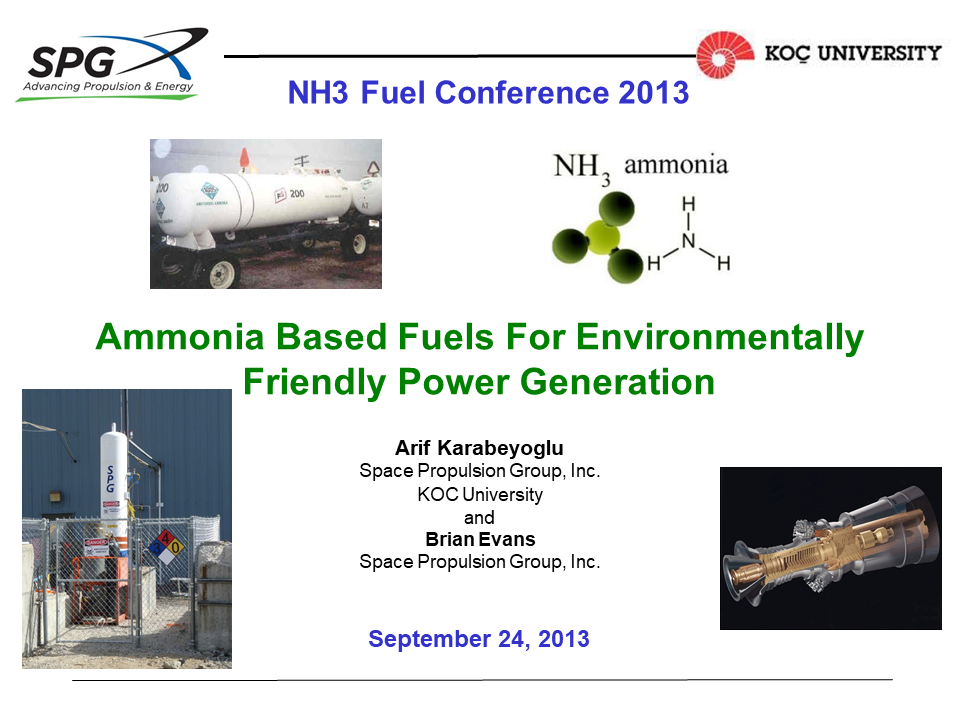
California Law requires: — All motor vehicle fuel must have a consensus organization fuel quality standard. In absence of such a standard, a user may obtain a “Developmental Engine Fuel Variance” for the purpose of developing a consensus organization standard. — Devices that measure for purposes of charging are type approved for product delivered and sealed by a Weights and Measure official. — Fuel dispensers are labeled in accordance to State and Federal requirements. — Unit of sale be in dollars per gallon or liter. The author provides an overview of these areas and information on how to obtain a…

Making and Treating NOx formed in NH3 Engines
Presentation

Ammonia has real promise as a green renewable fuel; however its use is not without some of the drawbacks endemic to high temperature combustion processes. Chief among them is the potential for NOx formation in nitrogen-rich oxidizing environments. Nitric and nitrous oxides are prime culprits that plague both entrenched hydrocarbon internal combustion technology but also emerging technologies like ammonia-as-a-fuel. Nitric oxide is implicated in photochemical ground-level ozone production in urban areas. Nitrous oxide is its own double-edged environmental sword, being both a potent tropospheric green-house gas as well as a principle agent in renewed stratospheric ozone-depletion (Science 2009, v326, p.…

Ammonia Production Using Wind Energy: An Early Calculation of Life Cycle Carbon Emissions and Fossil Energy Consumption
Presentation

Industry professionals and others have begun to consider the use of ammonia as a substitute for fossil energy in the fuel, fertilizer, and chemical sectors. Several factors are driving this concept; including, energy security concerns, the potential for economic development, and reducing the environmental consequences of fossil energy use. In terms of environmental concerns, it is important to determine the potential impacts of producing ammonia before a major switch to ammonia can be considered. This study examined fossil energy use and carbon emissions in the production of ammonia, using life cycle assessment (LCA) methods to analyze production at a novel…

Production of Ammonia and Nitrogen Fertilizers based on Biomass - Research Efforts in Sweden
Presentation

The Swedish University of Agricultural Sciences have been conducting research on production of ammonia and nitrogen fertilizers based on bioenergy since 2006, in the last years in co-operation with Lund University and University of Minnesota. The research has so far been theoretical — studying the techno-economics and the potential environmental impacts. Several possible pathways for ammonia and ammonium nitrate fertilizer production have been explored, e.g. gasification of woody biomass, reforming of biogas from anaerobic digestion, integration in biomass CHP plants. A selection of results from the past years research can be presented: Techno-Economic Assessment of Non-Fossil Ammonia Production P. Tunå,…