Site items in: Content by Author Trevor Brown

Maritime decarbonization is a trillion dollar opportunity
Article

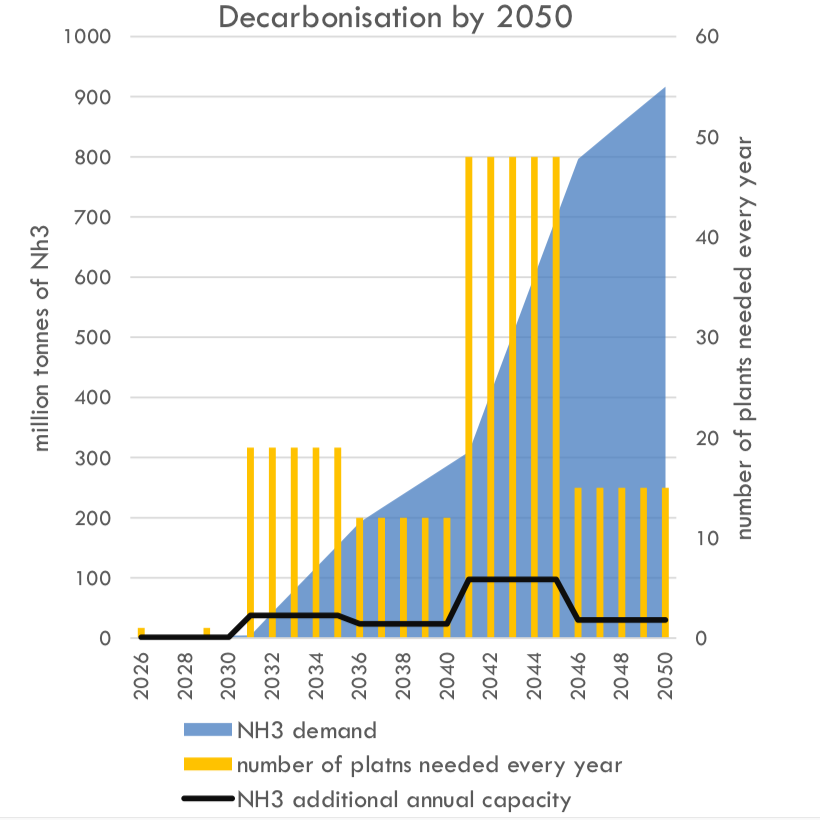
In January 2020, the Global Maritime Forum published new analysis that calculates "the capital investment needed to achieve decarbonization" in line with the International Maritime Organization's Initial GHG Strategy. The result of this analysis, which assumes that ammonia will be "the primary zero carbon fuel choice adopted by the shipping industry," is an aggregate investment of between $1 trillion and $1.4 trillion dollars, from 2030 to 2050, or roughly $50 to $70 billion per year across two decades. Ship-side costs are only 13% of this number. The bulk of the investment will be directed towards green ammonia plants for maritime fuel synthesis. By 2050, this global fuel demand is estimated to be more than 900 million tons per year of green ammonia, more than five time today's total global output of conventional ammonia.

MAN ammonia engine update
Article

In November 2019, MAN ES published a technical paper describing the design and performance of its two-stroke green-ammonia engine. The paper also quietly announces the intentions of MAN ES to exploit ammonia energy technologies in a new business case, Power-to-X (PtX, "the carbon-neutral energy storage and sector coupling technology of the future"). In other words, MAN is moving into green ammonia fuel production.

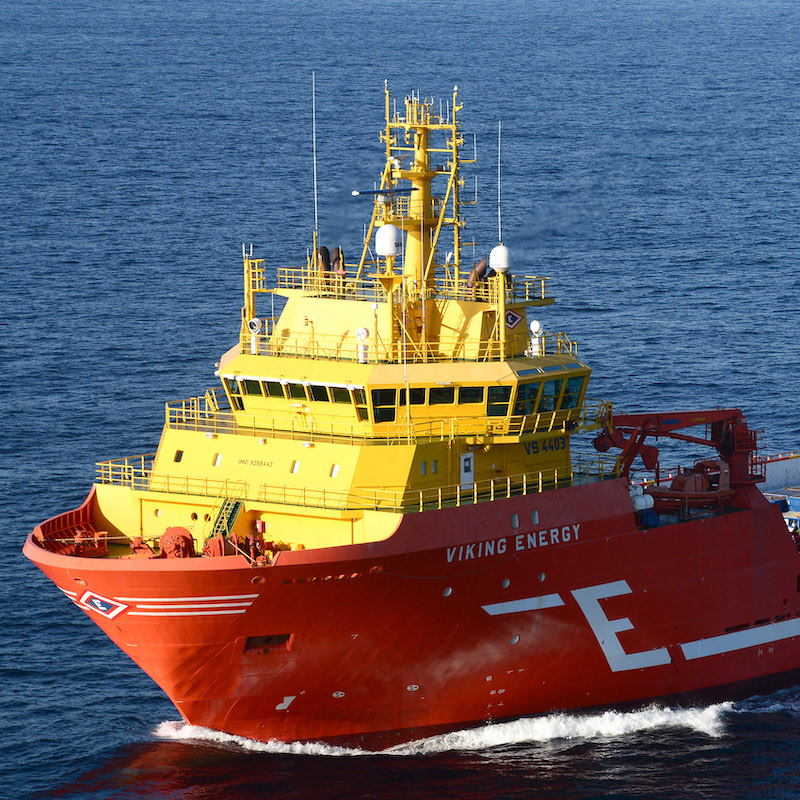
Viking Energy to be retrofit for ammonia fuel in 2024
Article

This morning, it was announced that the "Viking Energy," a supply vessel for Equinor's offshore operations, will be modified to run on a 2 MW direct ammonia fuel cell. This will be a five year project: the technology will be scaled-up on land before being installed on the vessel, which will begin a year of GHG emission-free operations in 2024. The Norwegian partners leading this "world's first" project include shipowner Eidesvik, contractor Equinor, and ammonia producer Yara, as well as Wärtsilä (Wärtsilä Norway), responsible for power technology and ammonia storage and distribution systems, and Prototech, delivering the fuel cell system.

Tri-State announces clean energy plan, retires coal assets
Article

Yesterday, Tri-State Generation & Transmission Association launched its "transformative" Responsible Energy Plan, which will "dramatically and rapidly advance the wholesale power supply cooperative’s clean energy portfolio." Last week, the utility announced the retirement of its last coal-fired power plants in New Mexico and Colorado. These two announcements provide context for a presentation at the Ammonia Energy Conference in November 2019, entitled Market Integrated Ammonia. Its conclusion — highly relevant for a utility that is closing its coal plants and increasing renewables to 50% by 2024 — is that in a wholesale electricity market with increased volatility, renewable ammonia could be produced at the extremely low cost of $96 per tonne.

Ammonia energy is now a talking point for CEOs
Article

Chief executives of major corporations are now talking about ammonia energy. This represents another crucial step up the learning curve for clean industry: knowledge about ammonia's potential has successfully spread from the R&D department to the executive suite. This is the difference between development and deployment. The fertilizer industry saw this in 2018, when the CEOs of first movers like Yara and OCP announced green ammonia pilot plants. These latest announcements come, however, from the shipping and power sectors — far bigger industries, with no existing ammonia business — and they focus on the use of green ammonia: for fuel and for profit.

Updating the literature: Ammonia consumes 43% of global hydrogen
Article

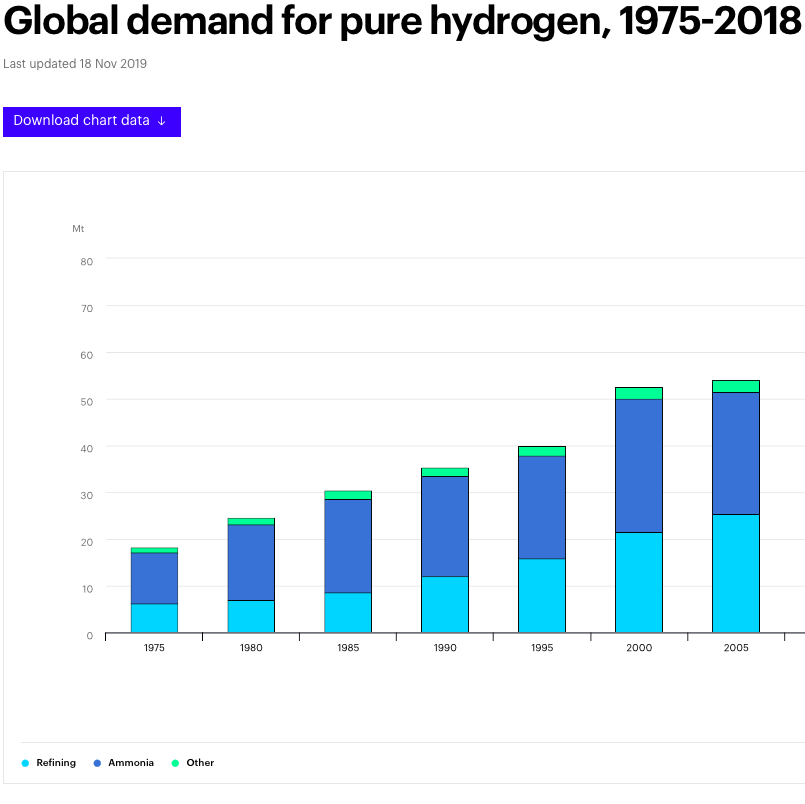
For years, many people — myself included — have been saying that ammonia consumes 55% of the hydrogen produced around the world. Although there are many authoritative sources for this figure, I knew that it was likely out of date. Until now, I had overlooked the International Energy Agency (IEA) 2019 report, The Future of Hydrogen, which provides up-to-date (and publicly downloadable) data for global hydrogen demand since 1975. According to the IEA, ammonia represented almost 43% of global hydrogen demand in 2018; refining represented almost 52%, and "other" demands accounted for 6%.

The cost of hydrogen: Platts launches Hydrogen Price Assessment
Article

What does hydrogen really cost? Apparently, there's now a good answer to this question. $0.7955 per kg. This is according to the new daily hydrogen price assessment launched yesterday by Platts. Price assessments like this are invaluable for thriving markets, supporting transparency and developing into the benchmarks and indexes that underpin investments, trade, and regulations. This is a welcome innovation from the universe of financial product development. It will be interesting to see how Platts's hydrogen prices evolve, in terms of the cost structure of hydrogen production, of course, but also from the perspective of ammonia energy. If the purpose is to support commodity trading, these price assessments must eventually expand to include hydrogen carriers — molecules, like ammonia, that can be stored and transported more economically than hydrogen itself — in other words, commoditized hydrogen.

Ammonia-fueled ships: entering the design phase
Article

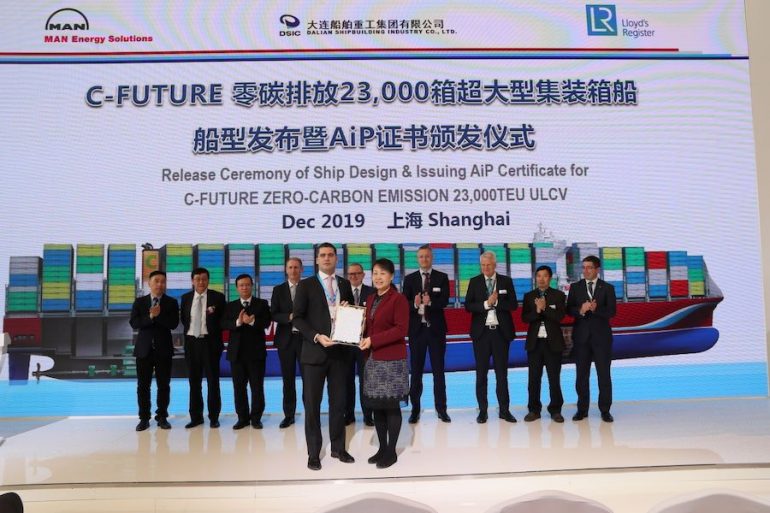
Three separate projects to design a range of ammonia-fueled vessels were announced last week at a shipping industry conference in China. Lloyd's Register has granted Approval in Principle (AiP) for the design of a 180,000 ton bulk carrier. ABS announced a project to "produce designs for an ammonia-fueled Chittagongmax container carrier of 2700 TEU capacity." And Lloyd's Register also announced a project for "an ammonia-fuelled 23,000 TEU Ultra-Large Container Ship (ULCS) concept design." All three projects are working with the two-stroke ammonia engine developed by MAN Energy Solutions, and all are led by major shipbuilders in China.